🎯 New here? BallCaddie matches golfers to the right ball. → Take the 90-second quiz
Back to BlogCallaway Supersoft Review (2026): The 49-Compression Value Bestseller
Independent 2026 Callaway Supersoft review: 2-piece ionomer, ~49 compression, ~$27. Robot-test read, Chrome Soft and Soft Feel splits, plus who it fits.
Answer a few questions about your swing and BallCaddie matches you against a 72-ball catalog.
Take the 90-second quizQuick answer
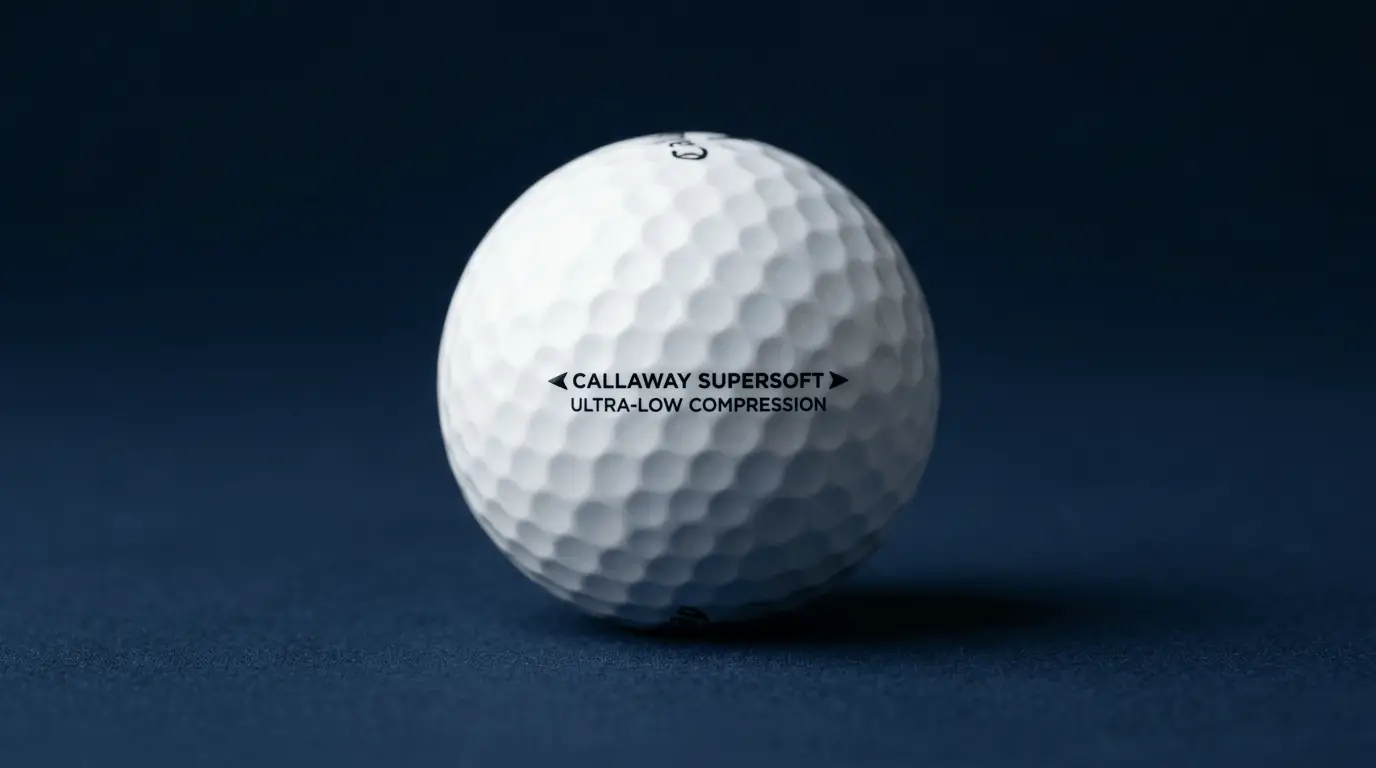
The Callaway Supersoft is a 2-piece ball with an ultra-soft core, Callaway’s hybrid ionomer cover, about 49 compression on MyGolfSpy’s 2026 gauge, and a street price around $27 a dozen. Ball Lab scored the 2026 ball 74 (C, Not Recommended), and it was the slowest of 48 balls off the driver in the 2026 robot test. It fits driver swing speeds under 90 mph that want soft feel, low driver spin, and straight distance for value money. Around the green its ionomer cover runs out instead of checking. The best fit is a beginner or senior swinging under 90 mph.
Where the Supersoft sits among soft value balls
| Ball | Compression | Cover | Layers | Greenside spin | MSRP |
|---|---|---|---|---|---|
| Maxfli SoftFli | ~35 | Ionomer | 2 | Low | $19.99 |
| Wilson Duo Soft | ~37 | Ionomer | 2 | Low | $24.99 |
| Bridgestone e6 Soft | ~45 | Surlyn | 2 | Low | $23.99 |
| Callaway Supersoft | ~49 | Ionomer | 2 | Low | $26.99 |
| Titleist TruFeel | ~70 | Ionomer | 2 | Low | $24.99 |
| Srixon Soft Feel | ~58 | Ionomer | 2 | Moderate | $24.99 |
Compression and MSRP values come from the BallCaddie catalog. Three balls on the value rack sit softer than the Supersoft: the Maxfli SoftFli (~35), the Wilson Duo Soft (~37) and the Bridgestone e6 Soft (~45).
The Supersoft launched in 2014 with a claimed 38 compression, and retailers still quote that number. Callaway’s current product page doesn’t list one. Independent gauges read the ball firmer. MyGolfSpy’s Ball Lab measured 36 balls from three boxes in August 2026 and got an average of 44, with individual balls running from 40.3 to 53.8. That 13.5-point spread is the main reason the ball scored 74, a C grade and Not Recommended, with 3 bad balls in the 36. Two Supersofts can sit ten points apart, so treat any single number as approximate. The golf ball compression chart plots every model on one calibrated gauge.
Callaway Supersoft compression
The BallCaddie catalog lists the Supersoft at 49, the figure in the 2026 robot-test dataset. Ball Lab’s 2026 sample averaged 44, with balls ranging from 40.3 to 53.8, so 49 falls inside the range Ball Lab measured. The 38 you still see at retail dates to the ball’s 2014 launch. On any of the three it sits at the soft end of the compression chart, built for driver speeds under about 95 mph.
What the Supersoft is
The Supersoft is the value anchor of Callaway’s ball line: two pieces, a soft core Callaway calls the HyperElastic SoftFast Core, and an ionomer cover. The current model is the 2025 Supersoft, launched in January 2025 alongside the updated ERC Soft and the Chrome Tour Triple Diamond.
Callaway brands the cover a Hybrid Cover. Earlier Supersofts borrowed the recipe from the Callaway ERC Soft (~60): an ionomer blended with a Dow Paraloid impact modifier. Callaway calls the 2025 cover a new system and says it adds soft feel and durability, without naming what’s in the blend. The 332-dimple HEX Aerodynamics pattern carries over, tuned for a high, low-drag flight that helps slower swings carry.
Listed at $26.99 in the BallCaddie catalog and $26.97–$27.99 at Callaway, DICK’S, Amazon and Walmart when we checked on October 3, 2026 (the matte colors run a dollar more), it sits in the value tier. The current model appears on the USGA conforming ball list for tournament play. Verify the exact colorway before a competition, since the list updates monthly.
Performance
The Supersoft does the slow-swing job well and gives up ground on fast swings and around the green.
Driver
Off the tee you get low spin and high launch. That pairing takes side spin off a slower swing’s miss, which is why slicers tend to see straighter drives with it. How much distance you give up depends on swing speed. In the 2026 robot test at 116 mph, the Supersoft had the lowest ball speed of 48 balls (165.0 mph against a field average of 168.5) and finished 43rd in total distance, about six yards under the average. At 86 mph it was still the slowest ball off the face and had the shortest carry of the 48, but it also had the lowest driver spin in the field and rolled out to 29th of 48 in total distance, about a yard under the average. Under 90 mph you’re trading a yard for straighter drives. Over 100 mph the trade costs too much.
Irons and approach
The high launch follows into the irons, where the soft core helps players who fight to get mid-irons airborne. Above 90 mph some golfers find the feel a touch mushy on crisp iron contact and step up to a firmer ball like the Titleist Velocity (~90) or Srixon Q-Star Ultispeed (~85). Below 90 mph the Supersoft’s launch and feel are the better match through the bag.
Greenside spin
Greenside spin is the Supersoft’s ceiling, and it’s low. The ionomer cover puts durability and distance ahead of wedge bite, so the ball runs out where a urethane ball checks. On the 35-yard wedge shot in the 2026 robot test it had the second-lowest spin of 48 balls. Plan on bump-and-run.
On a standard pitch it stops dependably; on a firm, fast green it gives up several yards of bite to a cast-urethane ball like the Callaway Chrome Soft (~77). If you score on spin from inside 100 yards, that gap is the whole argument for stepping up a tier — the trade-off is laid out in urethane vs. ionomer covers.
Putter feel
Off the putter the Supersoft is soft and quiet, which is what a low-compression core under an ionomer cover gives you. If firmer tour balls sound clicky to you, you’ll probably like the muted response. You may also get a little less feedback on lag putts. Which one you want is a matter of taste.
Supersoft vs Callaway Chrome Soft
The Callaway Chrome Soft (~77) is the ball Supersoft shoppers cross-shop most, and the two aren’t aimed at the same golfer. The Chrome Soft is a 3-piece urethane tour ball at $57.99; the Supersoft is a 2-piece ionomer value ball at $26.99. That’s more than double the price for a urethane cover that grips the grooves and a firmer core built to compress at 85-105 mph.
Golf Monthly’s 2022 head-to-head found the same split: the Supersoft kept up on distance through the bag, but on chips and pitches it lacked the bite of the Chrome Soft. Under about 90 mph with distance and straightness as the priority, the Supersoft is the smarter buy — you don’t generate enough clubhead speed to cash in everything a urethane ball offers. From 90-105 mph with a sharp short game, the Chrome Soft earns its premium. The Callaway Chrome Soft review covers that ball in full.
Supersoft vs the Srixon Soft Feel
Inside the value tier, the Srixon Soft Feel (~58) is the Supersoft’s most-compared rival, and the split is swing speed. The Supersoft is the softer ball (49 against 58) and the better answer under about 85 mph if you want the softest feel and highest launch. The Soft Feel firms the formula up for the 88-95 mph player who wants soft feel without bleeding ball speed at the top of that range.
Price is close: the Soft Feel lists at $24.99 and the Supersoft sits within a few dollars of it, both 2-piece ionomer balls with low driver spin and a capped greenside ceiling. A slow swinger chasing maximum softness takes the Supersoft; a moderate swinger who wants a touch more ball speed takes the Soft Feel. The Srixon Soft Feel review and the best low-compression golf ball guide rank the rest of the soft field.
Supersoft Max: the oversized option
Callaway also sells the Supersoft Max, a larger-than-standard version of the same ball. An oversized ball can still be legal for tournament play — the Rules of Golf set a minimum diameter of 1.68 inches and a maximum weight, but no maximum size — as long as the specific model and colorway appears on the USGA conforming ball list. The Max measures about 1.73 inches across against the standard 1.68, keeps the low compression, and swaps the hybrid cover for a tri-blend ionomer. Callaway calls it its longest ball for slow-speed players, and it’s aimed at seniors, beginners, and anyone who struggles to get the ball airborne. If you want the softest, easiest-launching option and don’t need greenside bite, it’s worth a look; everyone else is better served by the standard Supersoft.
Swing-speed fit
The Supersoft’s window is slow-to-moderate. Callaway doesn’t publish a swing-speed number for it; the BallCaddie catalog maps it to swings under about 95 mph, and the robot data above says the fit is best under 90. The mechanics are in the swing-speed pillar at how to choose the right golf ball for your swing speed: a firm ball still works at slow speeds (in 2026 robot testing at 86 mph, the softest balls were the slowest off the driver), so the Supersoft earns its spot with feel, high launch and low driver spin. TrackMan’s amateur data puts the average golfer’s driver swing at 94 mph, near the top of the Supersoft’s range.
Above roughly 100 mph the soft core costs too much ball speed, so those players belong on a firmer multi-layer ball. The best golf ball for a slow swing speed guide is the better entry point if you’re well under 85 mph and want the full short list.
Who should play it
- Your driver swing speed is under about 90 mph and you want a soft feel.
- You’re a beginner or high handicapper who wants low driver spin to take a slice out of play.
- You play a lot of cold-weather or shoulder-season golf — the soft core stays pleasant to hit below 50°F, where a firm tour ball turns harsh.
- You want soft feel and durability for value money and don’t score on greenside spin.
Who should skip it
- You swing over 100 mph. You’ll give up ball speed and carry, so look at a firmer tour ball like the Callaway Chrome Tour (~94).
- You score on greenside spin from inside 100 yards. The ionomer cover caps wedge bite; a urethane ball like the Callaway Chrome Soft is the fix.
- You want the firm, penetrating flight of a tour ball. The Supersoft launches high and lands soft by design.
- You want a soft value ball with better test results. The Titleist TruFeel (~70) at $24.99 finished 4th of 48 for total distance at both 86 and 102 mph in the 2026 robot test.
How BallCaddie decides when the Supersoft is the answer
The Ball Fitting Report breaks the estimated per-round cost of a mismatched ball into four places — short game, feel and consistency, ball flight, speed — with a figure and a mechanism for each. The Supersoft decision runs on the same split. When most of a sub-90-mph golfer’s estimate sits under feel and flight, a low-compression ball at a value price can deliver the scoring bump of a dozen costing twice as much; when most of it sits under the short game, the urethane cover is the part worth paying for. Budget is one of the scored inputs, and fit carries the most weight.
Six report sections are free after the 90-second quiz. The seventh names your #1, #2, and #3 — $29, one time. The stroke figures are estimates based on published research, and results vary by player.

The strokes breakdown from a real report — a sample 12-handicap profile at 85–99 mph. See every section of the report.
The next step
The Supersoft earns a sleeve trial for any sub-90-mph golfer who wants real softness and durability without paying urethane prices. BallCaddie is brand-neutral and doesn’t sell balls, so no pick earns us a margin.
The BallCaddie fitting quiz takes 90 seconds. You answer for swing speed, miss pattern, greenside priority and budget, and we score the full catalog against your answers, value dozens included.
Related guides:
- How to choose the right golf ball for your swing speed - the swing-speed pillar mapping speed bands to compression and spin tiers, with the under-90-mph case the Supersoft is built for.
- Golf ball compression chart - the compression pillar plotting every ball on one calibrated gauge, including where the Supersoft’s old 38 label lands against gauge-measured numbers.
- Best low-compression golf ball - the ranked soft-ball field where the Supersoft competes with the SoftFli, Soft Feel, and TruFeel.
- Best value golf ball in 2026 - value-tier picks at every swing speed, from ionomer two-piece balls to discount urethane.
- Best golf ball for a slow swing speed (under 85 mph) - the swing-speed entry point below 85 mph, where the Supersoft sits against the rest of the ultra-low-compression field.
- Srixon Soft Feel review (2026) - the closest value-tier rival at ~58 compression, and the swing-speed split that decides between them.
- Callaway Chrome Soft review - the urethane step up inside the Callaway line for players who score on greenside spin.
Key takeaways
- The Supersoft is a 2-piece ionomer value ball: ~49 compression in the 2026 robot-test dataset (38 at its 2014 launch), listed at $26.99 in the BallCaddie catalog and about the same at retail.
- Ball Lab scored the 2026 ball 74 (C, Not Recommended, 3 bad balls in 36), and at 86 mph it had the slowest ball speed and shortest carry of 48 balls in the robot test.
- It fits swings under about 90 mph. Low driver spin and high launch straighten out slower-swing misses and help the ball carry.
- Greenside spin is low. It runs out instead of checking, the ceiling for a 2-piece ionomer cover.
- Above 100 mph it gives up ball speed and carry — step up to a firmer tour ball like the Chrome Tour.
- Cross-shop the Titleist TruFeel (~70), the better-tested soft ball, the Srixon Soft Feel (~58) at 88-95 mph, and the urethane Callaway Chrome Soft (~77) if you score on wedge spin.
- The oversized Supersoft Max is the easier-launching variant, and Callaway says it still conforms to the Rules of Golf.
Sources
Stop guessing your golf ball
Take the 90-second fitting quiz · matched from a 72-ball catalog · sign up to see your match
Take the quiz →Related posts
Independent 2026 Titleist TruFeel review: 2-piece ionomer, ~70 compression, $24.99. Who it fits, the Tour Soft and Velocity splits, and the greenside reality.
Independent 2026 Titleist Tour Soft review: 2-piece elastomer cover, ~88 catalog compression, $39.99 MSRP. Robot test data, lineup positioning, who plays it.
Independent Titleist Velocity review: 2-piece ionomer distance ball, $29.99, low spin, longest of 48 at 102 mph in 2026 robot testing. Lab data and who it fits.
Callaway Chrome Tour Triple Diamond review (2026): the lower-spin tour ball for 105+ mph swings, the robot distance data, and who it actually fits.
Frequently asked questions
- What compression is the Callaway Supersoft?
- The BallCaddie catalog lists the Callaway Supersoft at 49, the figure from the 2026 robot-test dataset. The ball launched in 2014 with a claimed 38, a number retailers still quote, though Callaway's current product page doesn't publish one. Ball Lab's 2026 gauge averaged 44 across 36 balls, with individual balls reading from 40.3 to 53.8. All three numbers describe a soft, low-compression ball: softer than the Srixon Soft Feel (~58), firmer than the Maxfli SoftFli (~35).
- What swing speed is the Callaway Supersoft designed for?
- The BallCaddie catalog maps the Supersoft to driver swing speeds under about 95 mph, and it fits best under 90. Callaway doesn't publish a swing-speed number for it. The low-compression core feels soft and keeps driver spin down, and the high launch helps slower swings carry. At fast speeds the soft core gives up ball speed — in the 2026 robot test at 116 mph the Supersoft was the slowest of 48 balls off the driver — so swings over 100 mph usually get more from a firmer multi-layer ball like the Callaway Chrome Tour (~94) or another tour model.
- Callaway Supersoft or Chrome Soft - which should I play?
- Play the Supersoft (~49) if your driver swing is under about 90 mph and you want soft feel, straight distance, and a value price around $27. Play the Chrome Soft (~77) if you swing 90-105 mph with a sharp short game and want the urethane cover's greenside bite, at more than double the price. The Supersoft is a 2-piece ionomer ball that releases around the green; the Chrome Soft is a 3-piece urethane tour ball that checks and spins.
- Does the Callaway Supersoft spin around the green?
- Greenside spin is low, the practical ceiling for a 2-piece ionomer ball. The Supersoft stops dependably on standard pitches but releases rather than checking on firm, fast greens, so it suits bump-and-run short game more than one-hop-stop wedge shots. The ionomer cover trades wedge bite for durability and distance. If you score on spin from inside 100 yards, step up to a urethane ball such as the Callaway Chrome Soft, which grips the grooves the Supersoft's cover can't.
- What is the Callaway Supersoft Max?
- The Supersoft Max is an oversized version of the standard Supersoft - a larger-than-normal ball aimed at seniors, beginners, and golfers who struggle to launch it. It measures about 1.73 inches across against the standard 1.68, keeps the low compression, and uses a tri-blend ionomer cover instead of the Supersoft's hybrid cover. Despite the size, Callaway says it conforms to the Rules of Golf: the USGA sets a minimum diameter of 1.68 inches and a maximum weight, but no maximum size, so a bigger ball is legal as long as the specific model appears on the USGA conforming ball list. Most players are better served by the standard Supersoft.
- Is the Callaway Supersoft good for beginners and cold weather?
- Yes on both. The Supersoft is one of the more sensible picks for beginners and high handicappers under 90 mph: low driver spin straightens a slice, the high launch gets the ball airborne, and the durable ionomer cover survives cart paths for plenty of rounds. The low-compression core also keeps a softer feel below 50°F than a firm tour ball, so it's a comfortable shoulder-season option; distance in the cold comes down to keeping the ball warm. The current Supersoft appears on the USGA conforming ball list for tournament play; verify the exact colorway before competing.
Stop guessing your golf ball
Take the 90-second fitting quiz · matched from a 72-ball catalog · sign up to see your match
Take the quiz →