
Titleist Tour Soft Review (2026): The Two-Piece Ionomer Sweet Spot
Independent 2026 Titleist Tour Soft review: 2-piece elastomer cover, ~70 catalog compression, $39.99 MSRP. MyGolfSpy data, lineup positioning, who plays it.
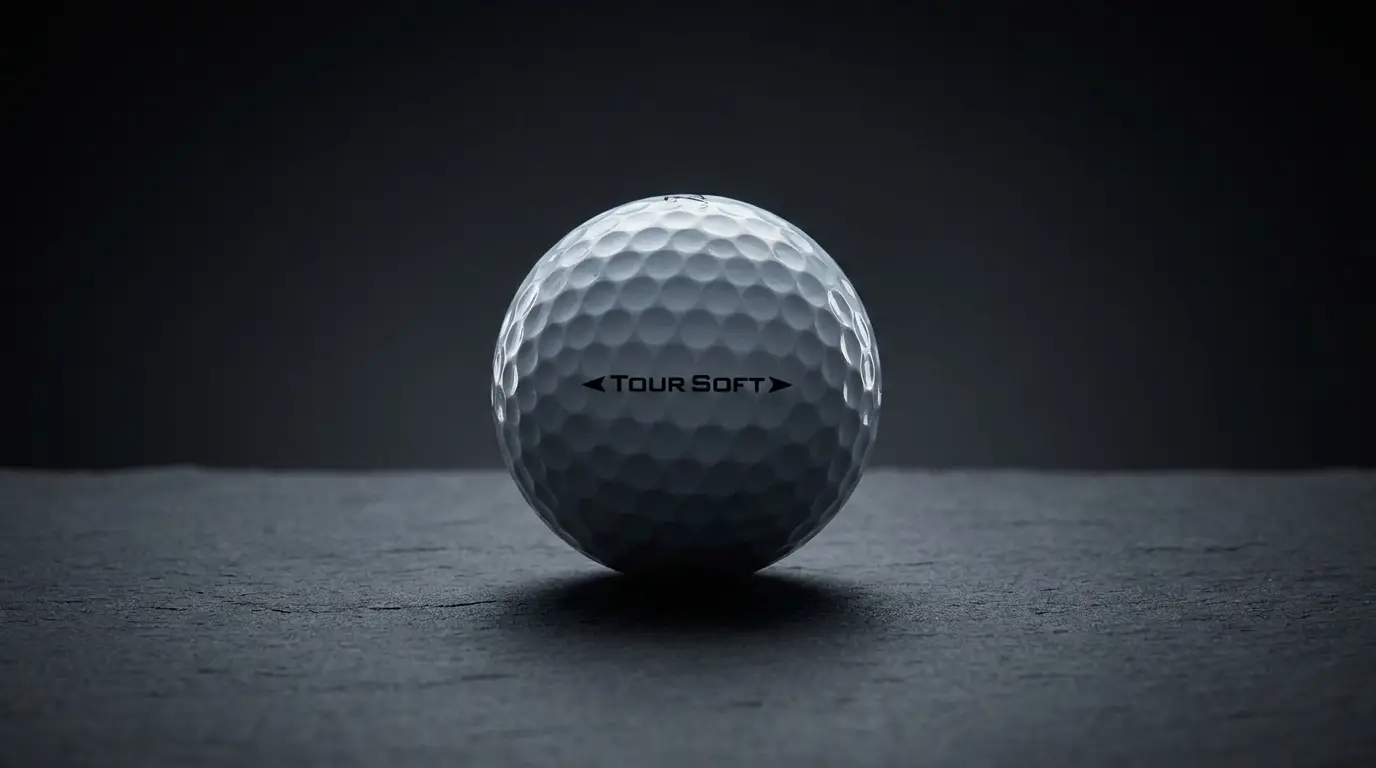
Quick answer
The Titleist Tour Soft is a 2-piece ionomer ball with a proprietary elastomer cover, an MSRP of $39.99 per dozen, and a compression profile around 70 in the BallCaddie catalog. It sits between the TruFeel and Pro V1 in the Titleist lineup. The best fit is a moderate-speed player around 90-105 mph who wants more short-game control than a basic distance ball without paying full urethane pricing.
How the Tour Soft fits inside the Titleist lineup
| Spec | TruFeel | Velocity | Tour Soft | AVX | Pro V1 |
|---|---|---|---|---|---|
| Compression (catalog) | ~50 | ~70 | ~70 | ~77 | ~87 |
| Cover | Ionomer | Ionomer (NAZ+) | Elastomer (ionomer) | Urethane | Urethane |
| Layers | 2 | 2 | 2 | 3 | 3 |
| Trajectory | High | High | Mid | Low | Mid |
| Long-game spin | Low | Very low | Low | Low | Mid |
| Greenside spin | Moderate | Moderate | Moderate | Tour | Tour |
| MSRP | $24.99 | $29.99 | $39.99 | $50.00 | $57.99 |
Compression and MSRP values come from the BallCaddie catalog. Titleist’s own Tour Soft product page positions it as softer and spinnier than Velocity, but firmer and higher flying than TruFeel.
Why the Tour Soft exists
The Tour Soft answers one lineup question: how much feel and short-game spin can Titleist build into a two-piece ionomer ball before a golfer needs a urethane cover? It is above the TruFeel on compression, above the Velocity on short-game spin, and below the AVX and Pro V1 family on price.
Titleist announced the redesigned 2026 model in January. The core was resized to reduce long-game spin, the proprietary 4CE grafted elastomer cover was reformulated for softer feel, and the dimple package changed. The architecture stays simple: large rubber core, ionomer-family cover, two total pieces, $39.99 MSRP.
That construction explains both the appeal and the ceiling. Tour Soft produces low driver spin and moderate short-game spin relative to its price tier. It will feel livelier and more responsive around the green than a bargain distance ball, but it still will not behave like a cast-urethane Pro V1 when you ask for a low, high-spin wedge.
What independent testing says
The cleanest third-party read is that Tour Soft is competitive for distance, reliable for a two-piece ball, and limited mainly by cover material. In MyGolfSpy’s 2025 Most Wanted Ball Test, Tour Soft ranked competitively on distance at higher swing speeds - a result that held across the robot’s full speed range. Golf Insider UK’s TrackMan review found driver carry close to Pro V1 in one tester’s data, with less rollout and a wedge profile that supported the catalog’s moderate-spin positioning. MyGolfSpy’s Ball Lab rated Tour Soft’s consistency above average for its price tier.
Compression is simpler when you strip away cross-gauge noise. The BallCaddie catalog lists Tour Soft at about 70, while MyGolfSpy Ball Lab measured the prior generation at 67. Titleist does not publish a compression number. Treat it as a mid-compression ball: firmer than the ~50-compression Titleist TruFeel, softer than the urethane Pro V1 line, and best matched to the middle of the driver-speed bell curve. For a broader market map, use the golf ball compression chart.
Tour Soft vs Velocity
The Tour Soft and Velocity are the closest in-house comparison because both live below the premium Titleist tier and both use two-piece ionomer-family construction. Velocity is the cleaner distance-first answer. Tour Soft is the better fit when you still want short-game response and softer feel.
Golf Monthly’s TrackMan testing found Tour Soft generated more wedge spin than the Velocity - a meaningful gap for approach shots inside 100 yards. Carry distance off the tee was close enough that the decision should come down to scoring priorities: choose Velocity if your only brief is height and distance, choose Tour Soft if you want the same general distance tier with more control into greens.
The next Titleist step up is the AVX, which adds a urethane cover and lower flight at $50. The Pro V1 and Pro V1x become better answers when full-wedge spin, trajectory windows, and partial-shot control matter more than the $15-per-dozen gap.
Swing-speed fit
The Tour Soft’s catalog activation range is 90-105 mph driver swing speed. The mechanics are covered in the swing-speed pillar at how to choose the right golf ball for your swing speed: mid-compression balls tend to return the cleanest energy when the player sits in the middle speed band, while the mismatch penalty grows as speed rises.
Below 90 mph, the TruFeel is the better activation match and costs less. Above 105 mph, a multi-layer urethane ball starts to earn its premium because it holds speed and separates long-game and short-game spin more effectively. At the very fast end, the Pro V1x Left Dash is a more logical Titleist fit than Tour Soft.
The generation detail matters. The 2025 test used the prior-generation cover; Titleist’s January 2026 press release credits the new dimple package with additional distance gains not yet independently tested at robot scale. Until that testing exists, the conservative read is to trust the prior-generation robot data for broad fit and treat the 2026 dimple claim as a plausible but unverified improvement.
Who should play it
Play Tour Soft if you sit around 90-105 mph with driver, prefer Titleist, play enough rounds for the Pro V1 price gap to matter, and score with touch and trajectory more than maximum wedge spin. It is also a practical high-handicap ball for players who want durability, low driver spin, and a softer feel than Velocity.
Look elsewhere if your driver speed is below 90 mph, if your wedges need tour-level bite from 30-100 yards, or if your driver speed is well above 105 mph. Those golfers are usually better served by TruFeel, AVX, Pro V1, Pro V1x, or Pro V1x Left Dash, depending on speed and flight window.
The next step
The Tour Soft earns a sleeve trial for a moderate-speed golfer who wants Titleist feel and a real short-game upgrade over basic ionomer distance balls.
Two minutes through the BallCaddie fitting quiz scores the full catalog against your swing speed, miss pattern, greenside priority, and budget.
For deeper dives on the inputs this post pulls from:
- How to choose the right golf ball for your swing speed - the swing-speed pillar mapping speed bands to compression and spin tiers with example balls in each.
- Golf ball compression chart - the compression pillar with MyGolfSpy Ball Lab measurements across the market, including the mid-60s landing point for the Tour Soft against the Pro V1 line.
- Pro V1 vs Pro V1x - the parent Titleist comparison that frames the upgrade decision from Tour Soft to the urethane tour-ball tier.
- Best value golf ball in 2026 - the value-tier picks at every swing speed, where the Tour Soft competes against the Kirkland Signature and Maxfli Tour.
- Urethane vs. ionomer golf balls - when the cover-material upgrade from the Tour Soft’s elastomer to a cast-urethane cover is worth the $15 jump.
- Callaway Chrome Soft review - the cross-brand reference point: 72-compression urethane against the Tour Soft’s mid-band elastomer profile.
Frequently asked questions
What swing speed is the Titleist Tour Soft designed for?
Titleist positions Tour Soft for moderate swing speeds, and the BallCaddie catalog maps it to roughly 90-105 mph driver speed. Slower players should compare TruFeel; faster players usually get more from a multi-layer premium ball.
What compression is the Titleist Tour Soft?
BallCaddie lists Tour Soft at about 70 compression. MyGolfSpy Ball Lab measured the prior generation at 67. Titleist does not publish a number, so treat it as mid-60s to low-70s and firmer than the ~50-compression TruFeel.
How is the 2026 Titleist Tour Soft different from earlier versions?
Titleist says the 2026 model was redesigned from core to cover, with a softer elastomer cover, lower long-game spin target, and a new dimple pattern. The 2025 independent test data used the prior-generation cover.
Tour Soft or Pro V1 - which one should I play?
Play Pro V1 if you need tour-level greenside spin. Play Tour Soft if you want Titleist feel, low driver spin, and useful short-game control for $39.99 instead of $57.99.
Is the Titleist Tour Soft good for high handicappers?
Yes, especially for high handicappers around 90-105 mph who want durability, low driver spin, and more wedge response than a basic distance ball. Below 90 mph, Titleist TruFeel is usually the better match.
Is the Titleist Tour Soft on the USGA Conforming Ball list?
Yes. Current Titleist Tour Soft sidestamps appear on the USGA Conforming Ball List. For tournament play, verify the exact model and variant because the list is updated monthly.